
Reliable instrumentation is crucial for safety, quality, and process efficiency, and accurate pressure measurement is key across various industries where such measurements are crucial. In oil and gas facilities, pharmaceutical plants, power generation units or calibration laboratories, pressure instruments are required to provide consistent and traceable results. That’s where a Dead Weight Tester can be of great value.
The calibration device is one of the most widely accepted pieces of equipment for generating and verifying pressure and is a primary standard for pressure. It offers extremely accurate reference values to aid technicians in the calibration of gauges, transmitters, sensors and other pressure measuring devices.
This guide discusses the principle of dead weight systems, their use, advantages, and why they are still the most popular solution for precision pressure calibration.
What is a Dead Weight Tester?
A dead weight system is an instrument that is used to produce known pressure readings by placing calibrated masses on a piston-cylinder system. The pressure generated is the ratio of the force of the weights to the effective area of the piston.
It’s controlled by basic physics, which provides the top level of precision and traceability and is trusted by calibration labs and industrial testing facilities.
Usually used to check and calibrate pressure gauges, pressure transmitters, pressure switches and other pressure measurement equipment, etc.
How Does a Dead Weight Calibration System Work?
The principle of operation is simple and very accurate.
A weight is placed on a piston assembly and calibrated. Pressure is created within the system as it is forced. The pressure created by a freely rotating piston is in equilibrium and is thus a very good reference pressure.
This usually requires the following steps:
- Applying calibrated masses
- Generating stable pressure
- Comparing readings from instruments to the reference pressure
- Identifying measurement deviations
- Keeping instruments in tune as necessary
This method ensures reliable and repeatable calibration results.
Types of Dead Weight Testers
There are different ranges and ways of generating pressure for different industries.
Hydraulic Dead Weight Tester
A pressure transmitter based on oil is called a Hydraulic Dead Weight Tester, which is usually recommended for high-pressure applications.
Advantages include:
- High-pressure generation capability
- Excellent measurement stability
- Superior accuracy for industrial testing.
- Calibratable in a calibration laboratory.
Such systems are commonly found in power plants, petroleum refineries and industrial manufacturing plants.
Pneumatic Dead Weight Tester
Pneumatic systems are used with air or gas as the pressure medium and are commonly used in low pressure applications.
Benefits include:
- Cleaner operation
- Easier maintenance
- For sensitive instruments: appropriate
- Ideal for laboratory environments
Importance of Pressure Calibration
Correct pressure measurement directly affects the process safety and efficiency. These can cause equipment failures, production losses, and compliance problems, even in the case of minor mistakes.
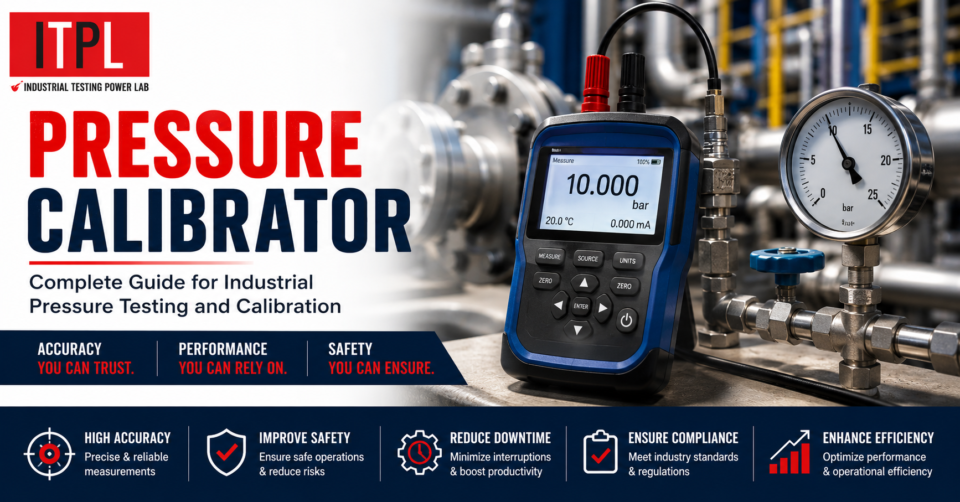
Industries can ensure measurement accuracy with the help of modern Pressure Calibration Equipment and get traceable calibration standards.
Regular calibration supports:
- Quality assurance programs
- Regulatory compliance
- Process optimization
- Equipment reliability
- Reduced downtime
In industries with strict standards, calibration cannot be an option; it is a must.
Applications Across Industries
There are numerous industries where dead weight calibration systems are utilized.
Oil and Gas Industry
Pressure instruments are vital monitoring devices in pipelines, storage tanks, compressors and drilling machinery. A good calibration guarantees operational safety and leak avoidance.
Power Generation
Pressure measurements are used in pressure systems of power plants, including boilers, turbines, and steam systems. Calibration enhances system reliability and efficiency.
Pharmaceutical Manufacturing
Process parameters must be closely monitored to ensure the product meets the required specifications and regulatory standards. Calibration is a useful tool for validating production equipment and monitoring systems.
Aerospace and Defense
Accurate pressure standards are needed to check critical instruments in aviation and defense applications in high precision testing environments.
Research and Calibration Laboratories
Dead weight systems are used as primary standards in advanced calibration and metrology applications in laboratories.
Dead Weight Tester vs Digital Pressure Calibrator
Both are beneficial technologies and have different functions.
Dead Weight Systems
- Extremely high accuracy
- Primary calibration standard
- Great for lab use!
- Excellent long-term stability
Digital Pressure Calibrator
- Portable and user-friendly
- Faster field calibration
- Automated measurement functions
- Ideal for maintenance purposes
Both are solutions are utilized by many organizations to obtain the best calibration performance.
Best Practices for Precision Pressure Testing
Proper procedures and equipment maintenance are needed to ensure reliable Precision Pressure Testing.
Follow these recommendations:
- Ensure that certified calibration weights are used.
- Keep Piston Cylinder assemblies clean.
- Keep equipment stored in controlled areas.
- Ensure tracking of standards.
- Schedule regular recalibration
- Follow manufacturer guidelines
Standard procedures help to ensure accuracy and prolong equipment life.
Emerging Trends in Pressure Calibration
Calibration technology keeps developing with the advancement of digitalization and automation.
Current trends include:
- Automated calibration software
- Digital pressure monitoring systems.
- Cloud-based calibration management
- Smart calibration workflows
- A comprehensive asset management solution.
- Systems based on wireless data acquisition.
These innovations enhance efficiency, yet with no compromise on the level of measurement confidence.
Frequently Asked Questions (FAQ)
Q1. What does a dead weight tester do?
Ans: It produces very accurate reference pressure readings for calibration of pressure gauges, transmitters and all other pressure measuring devices.
Q2. What makes a dead weight system so accurate?
Ans: It uses fundamental physical principles of mass, gravity and piston area to determine its measurement, and offers outstanding precision and traceability.
Q3. How do hydraulic systems and pneumatic systems differ?
Ans: Oil is used for hydraulic systems, which are used for high pressure calibration tasks, and air or gas for pneumatic systems, which are used for low pressure calibration tasks.
Q4. At what frequency should pressure instruments be calibrated?
Ans: The calibration period will vary based on the industry specific requirements, application environment and criticality of the instrument. Annual or scheduled calibrations are conducted at many facilities.
Q5. Are pressure gauges calibrated with a dead weight tester?
Ans: Yes. One of the most reliable methods of Pressure Gauge Calibration, and widely adopted in laboratories and industrial facilities.
Conclusion
Accurate pressure readings are essential for ensuring safety, efficiency, and product quality in industrial processes. The Dead Weight Tester is still one of the most accurate and reliable pressure calibration standards, with its high traceability and measurement stability.
From laboratory, power plant, pharmaceutical and manufacturing settings, these systems offer accuracy to ensure confidence in the measurement of critical instruments. With the right calibration methods and advanced testing solutions, companies can achieve more reliable operations, stay compliant, and maintain the sustainability of their processes.