
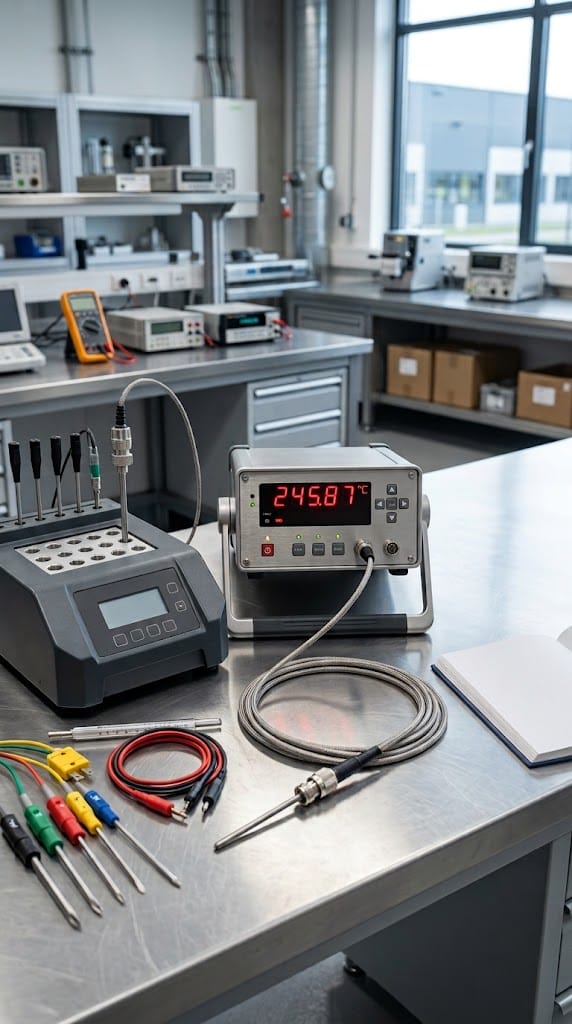
Reliable temperature measurement is required to ensure the quality of products, efficiency and safety in the operations of modern industries. In manufacturing facilities, pharmaceutical facilities, calibration laboratories, or power generation facilities, a slight change in temperature can influence the results of production and compliance with regulations. That is why a Precision Temperature Indicator is a very necessary tool of engineers, technicians, and quality people.
These instruments are designed to provide high accuracy and reliable readings that make them highly useful in the testing, calibration, monitoring processes and verification of equipment. This guide will teach you the mechanism of precision temperature indicators, their most significant characteristics, their use in industries and what factors to consider when choosing the appropriate solution.
What is a Precision Temperature Indicator?
A precision temperature indicator is an electronic device of high performance that measures and displays temperature and checks temperature with great accuracy. It operates with sensors (thermocouples, RTDs (Resistance Temperature Detectors), and thermistors) to give consistent and reproducible results.
Contrary to conventional temperature displays, they are intended to be used in environments where the precision of measurements is paramount. They are typically utilised in calibration laboratories, manufacturing plants, research facilities and industrial testing settings.
A Digital Temperature Indicator is also a common functionality of many modern systems, with the added benefits of data logging, multiple sensor compatibility and digital communication interfaces.
Working Principle
Its principle of operation is to convert the electrical signal produced by a temperature sensor into the correct temperature value.
The process is characterised by the following steps:
- Heat is monitored with a temperature sensor.
- The sensor produces an electrical signal that is dependent on the temperature.
- The signal is processed by the indicator with the help of high-resolution electronics.
- The internal compensation reduces environmental and measurement errors.
- The temperature is shown on a digital display.
Other sophisticated features are signal filtering, automatic linearization and sensor correction to enhance the performance of the overall measurements.
Key Features of a Precision Temperature Indicator
Modern temperature indicators are equipped with intelligent features that improve measurement accuracy and simplify industrial operations.
High Measurement Accuracy
High-accuracy temperature measurement is one of the largest benefits, allowing it to be accurately monitored to be used in calibration, testing, and quality assurance applications.
Multi-Sensor Compatibility
Most instruments are able to support a large number of sensor types, including:
- RTDs
- Thermocouples
- Thermistors
- Millivolt inputs
- Resistance inputs
This is dynamic and can be used to handle various industrial requirements in measurement by a single device.
High-Resolution Digital Display
A digital display that is easy to read allows checking temperature values easily without any misunderstandings in reading, and increases the efficiency of operators.
Data Logging and Connectivity
The advanced models are composed of numerous models, which involve:
- USB communication
- Ethernet connectivity
- Bluetooth support
- Data logging
- PC software integration
These characteristics make documentation easier and enhance traceability.
Wide Measurement Range
The modern indicators are widely used in the laboratory and in the industry, as they possess great ranges of temperatures.
Importance in Industrial Temperature Monitoring
Proper Industrial Temperature monitoring is unique to the stable production and consistency of products.
Precision indicators are used in industries to monitor:
- Manufacturing equipment
- Industrial furnaces
- Environmental chambers
- Boilers
- Heat exchangers
- Process pipelines
Constant check-ups can be used to initiate the detection of abnormal temperature changes before they lead to equipment breakdown or loss of production.
Applications Across Industries
Precision temperature indicators have numerous applications in diverse industries where high-level thermal readings are required.
Calibration Laboratories
These tools have many applications as standards of reference in temperature calibration processes.
They are used to check the operation of thermometers, sensors and process instruments when used in conjunction with Temperature Calibration Equipment.
Pharmaceutical Industry
The manufacturing processes that are sensitive to temperatures demand very precise monitoring to ensure that the quality of the product and its regulatory presence are not compromised.
Food and Beverage Processing
Proper temperature regulation facilitates food safety, consistency and quality assurance in production.
Power Generation
Turbines, boilers, generators and steam systems used in power plants depend on accurate temperature measurements.
Research and Development
Precision indicators are used in laboratories when testing a product, carrying out scientific experiments, or conducting validation studies where precise measurement is a requirement.
Benefits of Using Precision Temperature Indicators
There are various benefits of investing in a quality temperature indicator.
Improved Measurement Reliability
Proper readings help to minimise uncertainty and enhance a sense of reliability in the test results.
Better Quality Control
The constant temperature check helps in ensuring uniformity in production as well as minimising defects.
Enhanced Process Efficiency
The Reliable Process Temperature Measurement allows operators to improve system performance and minimize energy wastage.
Compliance with Industry Standards
Proper temperature checks are in line with ISO standards and other regulatory measures.
Reduced Equipment Downtime
Early warning of abnormal temperature situations can be used to avoid unforeseen machine malfunctions and expensive maintenance.
Choosing the Right Temperature Indicator
The choice of the proper instrument is based on a number of key factors.
Take into account the following characteristics:
- Measurement accuracy
- Supported sensor types
- Temperature range
- Display resolution
- Data logging capability
- Communication interfaces
- Calibration traceability
- Environmental protection rating
The choice of a device that can suit your application ensures increased long-term operation and measurement confidence.
Emerging Trends in Temperature Measurement
The development of temperature measurement technology has undergone changes with the level of digitalization and automation of the industry.
The recent trends include:
- Cloud-based temperature monitoring
- Wireless sensor integration
- Industrial IoT connectivity
- Remote diagnostics
- AI-assisted data analysis
- Smart calibration management
- Predictive maintenance integration
These technologies can be used to make quicker decisions and enhance efficiencies in operations in industrial settings.
FAQs
Q1. What is the use of a precision temperature indicator?
Ans: It is applied in industrial processes, laboratories, and calibration to measure, display and confirm temperatures with great precision.
Q2. What are the sensors that can be attached to a precision temperature indicator?
Ans: The majority of the instruments accommodate RTDs, thermocouples, thermistors, resistance inputs, and millivolt signals.
Q3. Why is accurate temperature measurement important?
Ans: Proper measurements are useful in ensuring the quality of products, enhancing process efficiency, aiding regulatory compliance, and minimizing operational risks.
Q4. Is it possible to do a calibration with precision temperature indicators?
Ans: Yes. They are extensively employed with temperature calibration systems to check and calibrate sensors and measuring instruments.
Q5. What are the industries that mostly use these instruments?
Ans: The industries that need precision temperature indicators include manufacturing, pharmaceuticals, power generation, food processing, research labs, aerospace and process industries.
Conclusion
Regular quality, efficiency of operation and adherence to regulations are not possible without a reliable temperature measure. A Precision Temperature Indicator is a highly accurate, stable and flexible instrument that can be used in demanding industrial and laboratory environments.
They can be used in making sound decisions in organisations based on trusted temperature data, either by calibration, process monitoring, equipment testing or quality assurance. It may lead to greater productivity, reduced downtime and long-term reliability of measurements for businesses that invest in modern temperature measurement technology and observe best calibration practices.
