Precision is no longer a desired feature in a contemporary industrial environment but a necessity. From huge turbines in electrical power plants to finely tuned chemical reactors in pharmaceutical laboratories, temperature measurement is a matter of safety, efficiency, and product quality. Sensors, however, are as good as the last calibration. It is here that the Thermocouple Calibration Furnace comes in handy. Being a high-precision temperature calibration system, it offers the stability and uniformity required to have a high temperature calibration furnace check sensors against international ITS-90 temperature standards and ISO 17025 requirements.
What is a Thermocouple Calibration Furnace?
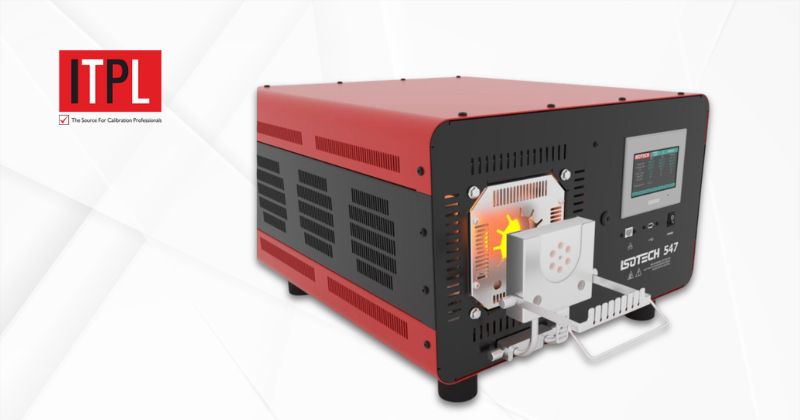
A Thermocouple Calibration Furnace is essentially an advanced heating system that is used to create a stable, repeatable, and highly uniform temperature zone furnace environment. An industrial calibration furnace (compared to a typical industrial oven) is designed to maintain a constant temperature with surgical accuracy, since large temperature variations or cold spots in the oven are unacceptable.
The major objective of the furnace is to offer a comparison calibration. Here, the technicians are in a position to know the deviation of the UUT and compensate it by attaching a unit under test (UUT) (RTD and thermocouple calibration probe) and a very precise reference thermometer calibration sensor.
The Science of the Uniform Temperature Zone
The length and stability of the uniform temperature zone in the high-temperature calibration furnace are among the most critical specifications. This is the region considered to have a zero temperature gradient in the furnace. When a furnace is of 100mm uniform zone, then any sensors in the zone will be experiencing exactly the same thermal energy. This allows the validity of the comparison between the reference and the test sensor to be both valid and devoid of spatial errors.
Key Features of a High-Accuracy Thermocouple Calibration System
To satisfy the stringent challenge of world metrology and NABL-approved calibration systems, modern furnaces are fitted with a couple of up-to-date engineering attributes:
- Multi-Zone Temperature Furnace Design: To counter the natural dissipation of heat at the ends of the furnace tube (called end-loss), higher-end models have more heating zones, usually three. The system provides a much more stable temperature zone as it is able to independently control the top, center, and bottom heaters to form a long, uniform temperature zone compared to the single-zone models.
- Improved PID Controllers: Accuracy is ensured by the use of advanced algorithms to avoid overshoot (where the temperature exceeds the desired temperature) as well as reduce thermal drift at the soaking point.
- Temperature Calibration Furnace Automation: Several systems have recently been fitted with digital interfaces (RS-485 or USB) and thus can be used with thermal validation equipment software. This automates the ramping, soaking, and data logging processes, which go a long way in minimizing human error.
- High-Grade Refractory Insulation: These furnaces achieve high-temperatures of up to 1200°C, with the outer casing being able to be touched, and this ensures that the furnace is more efficient and safer in the laboratory.
Types of Industrial Temperature Calibration Equipment
Not all the calibration operations necessitate a large-scale lab furnace. Some of the temperature sensor calibration systems used include:
1. Calibration Furnace in the laboratory
They are the gold standard of the industry. They are usually fixed and in a vertical position, and provide the biggest homogeneous areas and maximum stability. Primary metrology laboratories and compliance with ISO 17025 standards of calibration rely on them.
2. Portable Thermocouple Furnace Calibration
It is the perfect choice when industries such as power generation or offshore rigs cannot afford to transmit the sensors back to the central laboratory. These are rugged, lightweight units that are intended to be used in the lab grade without having to move to the lab, or even to the site where power plants are temperature calibrated.
3. Dry Block Calibrator
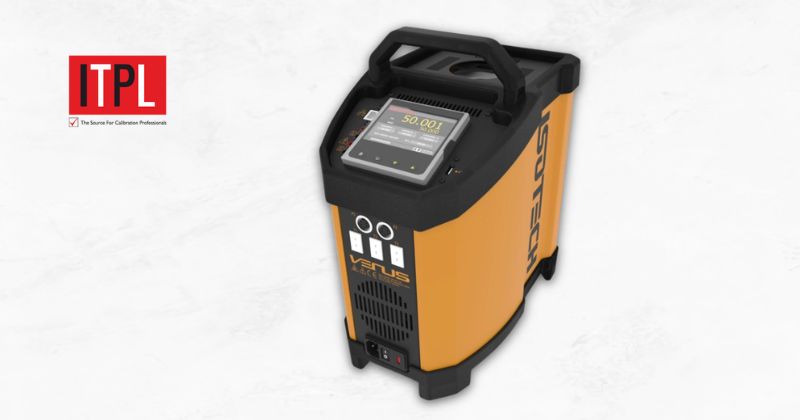
A dry block calibrator has sensors placed into holes made in a pre-drilled metal insert. Although they need less time than a standard furnace to be turned on and off, and therefore are typically employed in lower-precision field applications, where speed and size are more important than final uniformity.
4. Calibration Bath of Thermocouples
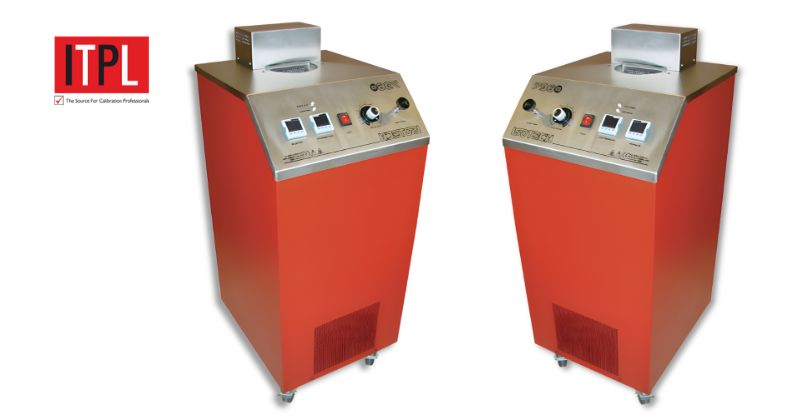
A stirred liquids medium (oil, water, or salt) is taken when calibrating short or odd-shaped sensors. A calibration bath has a lower temperature range than a high-temperature calibration furnace, but has unmatched thermal stability due to the elimination of air-based gradients by the liquid medium.
Applications: From Power Plants to Aerospace
Implementation of industrial metrology solutions and process industry calibration tools is crucial in the different industries where a 1-degree variance can lead to millions of dollars in losses.
- Oil and Gas Instrumentation Calibration: Accurate control of the distillation and safety is very necessary in refineries. Calibrated thermocouples eliminate hot spots in reactors, which may cause equipment breakdown.
- Power Generation and Distribution: This is to keep the turbines and boilers working in safe thermal operating conditions to avoid creep and mechanical breakdown. These sensors are always correct because this is due to the power plant temperature calibration.
- Aerospace Temperature Testing Machines: Engines and heat shields are subjected to intensive thermal test cycles that are confirmed using high temp furnaces to make sure they can survive the flight test.
- Pharmaceutical Temperature Validation: Drug production of life saving drugs will require documentation and traceability. The autoclaves and the reaction vessels are properly monitored with the help of furnaces.
Choosing the Best Thermocouple Calibration Furnace in India
In searching the thermocouple calibration furnace of laboratories, there are a number of factors that determine the performance and price of the thermocouple calibration furnace:
- Temperature Range: Does the system operate to the necessary 1200°C temperature of industrial probes, or do you require a special 1500°C furnace used with noble-metal thermocouples?
- Immersion Depth: The furnace should be deep such that the sensing element of the sensor is completely immersed in the furnace (so no error of heat escaping up the sensor body).
- Stability vs. Speed: A heavy furnace has large thermal mass, thus it is more stable but slow to change temperatures. The unit of a fast-cal is faster but can be characterized by a smaller uniform zone.
- Compliance: The unit should meet the standards of ITS-90 temperature and include a calibration certificate that is traceable.
Frequently Asked Questions
Q1. What does a Thermocouple Calibration Furnace do?
Ans: It is applied to precise RTD and thermocouple calibration through creating a uniform, steady, and high-temperature environment to be compared in testing.
Q2. Is a Uniform Temperature Zone so important?
Ans: When the temperature is heterogeneous through the heating chamber, the reference probe and the test probe will perceive different temperatures, and the calibration will be mathematically invalid.
Q3. To what industries is thermocouple calibration equipment required?
Ans: Any industry that has a need for thermal control, namely, power plants, oil and gas, aerospace, pharmaceuticals, and research labs.
Q4. What does a Dry block calibrator differ from a calibration furnace?
Ans: A dry block can be used in the field, and is quick, whereas a laboratory calibration furnace is much more deeply immersed and has better thermal stability, and the standard of high-precision lab work.
Q5. What is the frequency of calibration furnace characterization?
Ans: Although sensors are regularly inspected, the furnace itself is supposed to be thermally characterized every year. This is what we would recommend at itplindia so that the heating elements do not moved the uniform zone over time.
Conclusion
A Thermocouple Calibration Furnace is a much more than a heater; it is actually a precision instrument that ensures the integrity of the global industrial data. These systems enable engineers to work in absolute confidence by assuring them that the ISO 17025 is adhered to and the environment in which the reference thermometers are to be calibrated is stable.
We are ITPL India, the company that deals with delivering these high-performance industrial metrology solutions. Purchasing a unit with a high uniform temperature zone furnace of a provider you trust, such as itplindia.co.in, is the most important step to attaining reliable results that are to standards in your facility.
Make sure that it is peak precise and meets our world-class calibration level and turnkey lab systems. Call ITPL India today to be quoted a specific quote to meet your industrial requirements.